



What is adaptive cruise control?
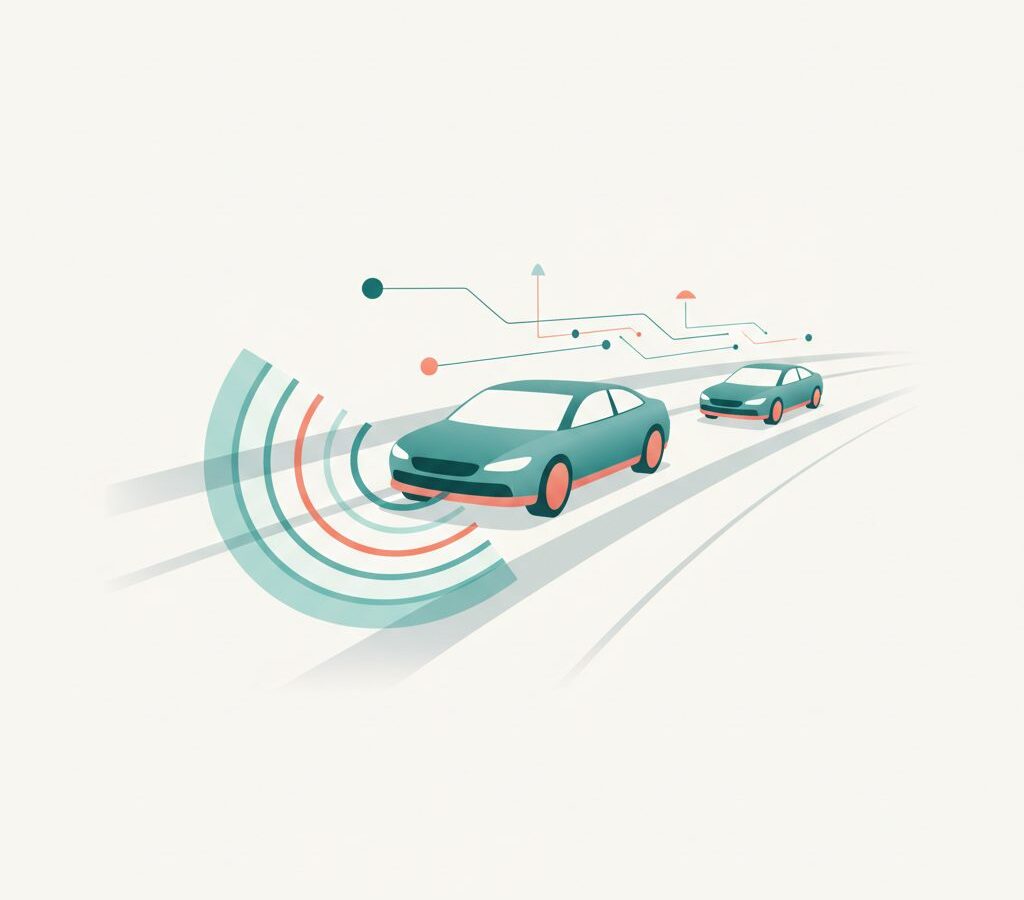
Adaptive cruise control — often shortened to ACC — is a feature built into many modern cars that automatically adjusts your speed to maintain a safe following distance from the vehicle directly ahead. Set a target speed and a preferred gap, and the system takes care of the throttle and brakes so you do not have to constantly tap the pedal in flowing traffic.
The technology has been around since the 1990s, when early systems relied on laser sensors. Today, most vehicles use radar combined with forward-facing cameras, and the systems are far more capable — many can handle stop-and-go traffic at low speeds, not just steady motorway cruising.
You will find it under different names depending on the manufacturer: Intelligent Cruise Control, Active Cruise Control, Dynamic Radar Cruise Control, and DISTRONIC, among others. The underlying technology is largely the same. It sits under the wider umbrella of advanced driver-assistance systems (ADAS) — electronic features designed to reduce driver workload and help avoid collisions. You can read more about related car technologies in our Lifestyle section.
How does adaptive cruise control work?
Radar and camera sensors
The core of any ACC system is its ability to see what is happening ahead. Most systems use a forward-facing radar sensor — typically mounted behind the front grille — that emits radio waves at 24 GHz or 77 GHz. Those waves bounce off objects ahead and return to the sensor. By measuring how long the round trip takes and how the frequency of the returning signal has shifted (the Doppler effect), the system calculates both the distance to the vehicle ahead and its relative speed.
Radar alone has a limitation: it can detect objects but struggles to identify what kind of object it is. That is where forward-facing cameras come in. The camera helps confirm that the object is a vehicle, track it through bends, and read lane markings. Some higher-end systems also add LiDAR for very precise distance measurement, though radar remains the workhorse sensor in most production cars. All that data feeds into the car’s electronic control unit many times per second.
Maintaining a set following distance
When you activate ACC, you choose two things: a target speed and a following gap — usually expressed in seconds (short, medium, or long, roughly two, three, or four seconds behind the car ahead). The gap is time-based, not a fixed number of metres, so at higher speeds the actual physical distance gets longer. That is intentional: braking from 70 mph takes more road than braking from 30 mph.
As long as the road ahead is clear, the car holds your target speed. When the system detects a slower vehicle in your lane, it closes the throttle and, if needed, applies gentle braking to bring your speed down until you match the car ahead while holding your chosen gap. If that car pulls away or changes lanes, your car smoothly accelerates back toward the target speed.
Automatic speed adjustment
Speed management is handled by reducing engine torque and, when that is not enough, applying the brakes. On many modern systems — particularly those marketed as ACC with Stop & Go — the car can slow all the way to a complete stop in a traffic jam, then pull away again once the car ahead moves (some require a tap of the accelerator or resume button after a full stop). If the vehicle ahead brakes hard and suddenly, ACC may not react fast enough on its own, which is why most systems are paired with Automatic Emergency Braking for sharper stops.
Adaptive cruise control vs regular cruise control
Standard cruise control, introduced in the 1950s, does one thing: hold a fixed speed. It has no awareness of traffic. If a slow lorry pulls in front of you, the system does nothing — you have to brake. Here is how the two compare:
- Traffic awareness: Standard cruise — none. ACC — continuously monitors the vehicle ahead.
- Speed adjustment: Standard — no. ACC — automatically slows and accelerates to match traffic.
- Stop-and-go capability: Standard — no. ACC (on many systems) — yes, down to a full stop.
- Weather sensitivity: ACC relies on sensors that heavy rain, snow, or fog can disrupt.
- Cost: Standard cruise is basic and near-universal. ACC is a premium feature, though increasingly standard.
Think of standard cruise control as a speed lock. ACC is more like a co-pilot for the throttle and brakes — useful, but still needing a pilot up front.
What it can and cannot do (and staying safe)
ACC is genuinely useful on motorways and in stop-and-go commutes. But it has hard limits every driver should know:
- It cannot steer. ACC only controls speed and braking. It does not keep you in your lane unless a separate lane-centering feature is active.
- It cannot change lanes. If a slow vehicle is in your lane, ACC matches its speed. It will not pass.
- It cannot see through bad weather. Heavy rain, snow, fog, or a muddy grille can block sensors, degrading the system. Many cars warn you and disable ACC in these conditions.
- It may not react to stationary objects. Most systems are tuned primarily for moving vehicles. A stopped car across a lane may not be detected reliably.
- It will not obey the speed limit. The system chases whatever target you set; it does not know the local limit unless paired with sign-recognition.
That last point matters. Research by the Insurance Institute for Highway Safety (IIHS) found that drivers using ACC exceeded the speed limit far more often than when driving manually, which the institute calculated raised fatal-crash risk. The IIHS has also said there is little evidence that partial automation actually prevents crashes, describing it more as a convenience feature than a safety technology. The practical rule is simple: treat ACC as a comfort aid, not a safety net. Keep your hands near the wheel and stay ready to brake or steer.
Is it the same as self-driving? No
This is the most important thing to understand about ACC, because the confusion can be dangerous. SAE International, the engineers’ body behind the widely used autonomy scale, places ACC on its own at Level 1 out of five levels. Level 1 means the system handles one aspect of driving (speed) while the human handles everything else — steering, watching the road, making decisions. When ACC is paired with lane-centering so both work at once, the package may qualify as Level 2 (partial automation), but the driver must still supervise continuously.
Full self-driving begins at Level 3 and above. No mainstream consumer vehicle sold in most markets operates at Level 4 or 5 in ordinary traffic. The gap between Level 2 and Level 3 matters enormously: at Level 2 — where every ACC-with-lane-centering system sits — you are legally and physically responsible for the car at all times. Marketing names that suggest hands-off driving still describe Level 2 systems, and misunderstanding this has contributed to serious accidents. Explore more about car technology and lifestyle topics on abcyapi.net.
The bottom line
Adaptive cruise control is one of the more practical features in modern cars. It genuinely reduces fatigue on long drives and keeps following distances more consistent than most drivers manage manually. If your car has it, learning to use it properly is worth the time.
But it is a driver-assistance tool, not a replacement for a driver. It cannot steer, cannot change lanes, and can be blinded by bad weather. Research suggests it may even encourage speeding when drivers set a target above the limit and stop thinking about it. And it is nowhere near autonomous driving, whatever the branding on the button says. Use it for what it is good at — steady motorway miles and slow urban crawls — keep your eyes on the road, and stay ready to take control. For more practical guides on cars and everyday tech, browse the Lifestyle section.